
Published September 30, 2026 · Updated October 2, 2026
Quick answer: Risk appetite is the types and amount of risk an organization is willing to accept in pursuing its strategies and objectives. It should be established within the organization’s risk capacity and translated into tolerances, thresholds, limits, and escalation rules so decision-makers know when exposure remains acceptable and when action is required. In practice, risk appetite connects strategy with day-to-day risk decisions rather than existing only as a policy statement.
To grow and succeed, organizations must pursue objectives, invest resources, enter new markets, adopt existing and new technologies, change operating models, or make significant decisions. Those decisions cannot be separated from their appetite for risk. Far from eliminating uncertainty, an organization’s risk appetite can guide the types and levels of risk it is willing to accept to achieve its strategy and objectives.
The challenge lies not so much in defining risk appetite as it is in making that guidance actionable. For example, the organization may state it has a low appetite for compliance risk, a moderate appetite for operational risk, or a higher appetite for innovation. Although these statements convey intent, they do not necessarily specify any acceptable levels of exposure, how and when to respond to changing conditions, or when to escalate decisions.
A well-defined risk appetite must go beyond a policy statement. COSO defines risk appetite as essential to decision-making and highlights its link to strategy and objectives. It should help management decide which risks to take, determine acceptable exposure, and identify when additional response or oversight is needed.
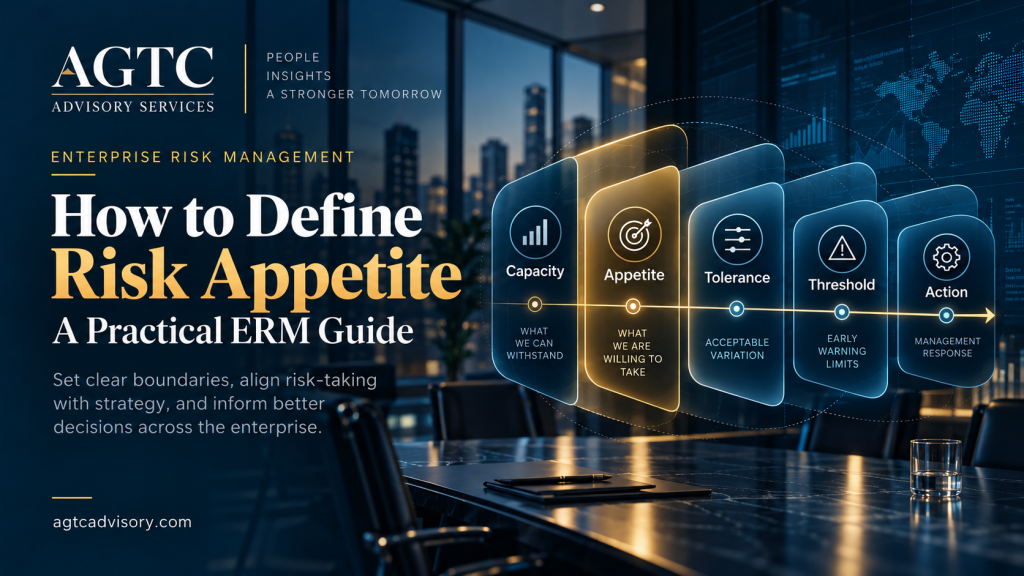
A practical approach should connect strategic direction with increasingly specific operating boundaries by linking risk appetite with risk tolerance, thresholds or limits, and escalation and action.
This guide outlines how to establish that connection. It differentiates risk appetite from related concepts such as risk tolerance and risk capacity, explains how to translate appetite into practical boundaries, and demonstrates how these boundaries support enterprise risk assessment, monitoring, escalation, and management decisions.
Contents
- What Is Risk Appetite?
- Risk Appetite, Risk Tolerance, Risk Capacity, Thresholds, and Limits
- Define Risk Appetite by Objective and Material Risk Area
- Translate Risk Appetite Into Tolerances, Thresholds, and Limits
- Connect Risk Appetite to Enterprise Risk Assessment
- Monitor Exposure Against Risk Appetite
- Common Risk Appetite Mistakes
- What Should an Effective Risk Appetite Framework Produce?
- From Risk Appetite to an Operating ERM System
- References and Further Reading
What Is Risk Appetite?
Risk appetite describes the types and amount of risk an organization is willing to accept in pursuing its strategies and objectives. The Institute of Internal Auditors uses this formulation in the current Global Internal Audit Standards, while COSO places the definition of risk appetite within strategy and objective-setting and connects it with creating, preserving, and realizing value.
Risk appetite is therefore not simply a statement about how much loss an organization can tolerate. It should provide guidance on the level of uncertainty the organization is prepared to accept while pursuing its objectives. Some risk-taking may be necessary to innovate, invest, grow, transform operations, or capture opportunities. Other exposures may warrant much tighter boundaries because of their potential effects on safety, liquidity, regulatory obligations, customers, operations, or other important objectives.
Risk appetite can also differ across risk types and objectives. An organization might be prepared to accept substantial uncertainty when developing a new product, yet have very little appetite for preventable employee harm or deliberate noncompliance. For that matter, describing the organization as generally “risk-taking” or “risk-averse” does not address the conditions under which risk-taking supports its strategy.
This distinction matters because broad labels such as low, moderate, or high do not automatically provide enough information for decisions. If management says that the organization has a “low appetite for operational disruption,” a business leader may still need to know what level of disruption is acceptable, how close current exposure is to that boundary, and what should happen when the boundary is approached or exceeded.
Risk appetite only becomes operational when leaders can consistently answer those questions. Clearly defined, it provides the organization’s overall direction. It also guides specific tolerances, thresholds, limits, monitoring arrangements, and escalation rules that help translate that direction into management decisions.
Risk Appetite, Risk Tolerance, Risk Capacity, Thresholds, and Limits
Risk appetite is easier to apply when it is distinguished from several related concepts. The terms risk appetite, risk tolerance, risk capacity, thresholds, and limits are sometimes used interchangeably, but they answer different management questions. Definitions also vary among standards, professional guidance, industries, and organizations. The important objective is to define the terms clearly and use them consistently within the organization’s risk-management framework.
| Concept | Management question | Practical meaning |
|---|---|---|
| Risk capacity | What can the organization withstand? | The organization’s ability to absorb risk without jeopardizing critical objectives, obligations, or continued viability. |
| Risk appetite | What risk are we willing to accept? | The types and amount of risk the organization is willing to accept in pursuing its strategies and objectives. |
| Risk tolerance | How much variation is acceptable? | The acceptable variation in performance or exposure within the context of an objective and the organization’s risk appetite. |
| Threshold | When should management attention or escalation begin? | An early-warning point that can trigger additional monitoring, investigation, review, response, or escalation. |
| Limit | What boundary requires stronger action if reached or exceeded? | A stronger operating boundary whose breach may require urgent response, senior authorization, or modification or cessation of an activity. |
Risk Capacity: How Much Risk Can the Organization Absorb?
Risk capacity represents the organization’s ability to absorb risk without jeopardizing critical objectives, obligations, or continued viability. Various factors can influence risk capacity. They may be financial resources, liquidity, operational resilience, regulatory requirements, contractual obligations, available capabilities, and other constraints.
Capacity and appetite are therefore not the same. An organization may have the capacity to absorb a particular exposure but choose not to do so. Conversely, management may be willing to pursue an opportunity but lack the financial, operational, or other capacity to accept the associated exposure.
Capacity is sometimes expressed quantitatively. This is particularly true for financial exposures. In other situations, the constraints may be qualitative or multidimensional. The purpose is not necessarily to calculate a single enterprise-wide capacity number, but to understand the boundaries within which risk-taking decisions must occur.
Risk Appetite: What Risk Are We Willing to Take?
Risk appetite represents a management choice within those constraints. The IIA’s current Global Internal Audit Standards define risk appetite as the types and amounts of risk an organization is willing to accept in pursuit of its strategies and objectives. The IIA
An organization does not need to operate at the edge of its capacity simply because that capacity exists. Management may deliberately establish appetite well inside that boundary because of strategic priorities, stakeholder expectations, uncertainty, the potential severity of consequences, or the availability of better alternatives.
Risk Tolerance: How Much Variation Is Acceptable?
For example, an organization may establish an objective for service availability and express a low appetite for significant service interruption. Tolerance can provide greater specificity by defining the amount of variation in service performance that management considers acceptable.
However, organizations and professional frameworks do not always use the term “risk tolerance” in the same way. Some use it broadly to describe acceptable risk boundaries. Others use it to describe deviations from appetite. Rather than pursuing a universally accepted definition, organizations should define what “appetite” and “tolerance” mean within their own framework and ensure that decision-makers understand the distinction. A key question management should answer is: How do we translate broad direction about risk-taking into boundaries that people can actually use?
Thresholds and Limits: When Does Exposure Require Attention?
Thresholds and limits make those boundaries increasingly operational.
A threshold can serve as an early-warning or escalation point. Crossing it does not necessarily mean that the organization has exceeded its ultimate acceptable exposure. Instead, it may trigger investigation, additional monitoring, management review, corrective action, or escalation before conditions deteriorate further.
A limit represents a much stronger boundary. Depending on the organization, exceeding a limit may require urgent responses. In some cases, a breach of limits may require senior authorization, formal acceptance of the exposure, or cessation or modification of the activity.
The distinction is useful because organizations do not have to wait for an unacceptable outcome before responding. A series of progressively more serious boundaries can provide management with time to act.
For example:
within tolerance → approaching threshold → threshold exceeded → limit approached or exceeded → escalation and action
The IIA’s current Standards reinforce the importance of having a defined process for risks that exceed appetite or tolerance, including considerations such as the timeliness and hierarchy of communication. The IIA
The Terminology Matters Less Than the Decision Logic
Organizations may legitimately use somewhat different terminology. One organization may call an early-warning point a threshold; another may call it a trigger. Some may use tolerance, while another organization uses a limit. Regulatory frameworks may also prescribe terminology for particular industries.
Consistency is therefore more important than imposing a universal vocabulary.
- What exposure will we accept in the pursuit of the objective?
- How do we know when the exposure moves beyond our desired boundaries?
- When must management review or escalate the situation?
- Who has authority to accept an exception?
- What action is required when a boundary is exceeded?
Start With Strategy and Objectives
Do not begin by selecting whether the organization’s risk appetite is low, moderate, or high. Begin with what the organization is trying to achieve and the uncertainty it must accept in pursuing those objectives.
Risk appetite should be connected to strategy because strategic choices inherently involve risk. Each time an organization enters a new market, introduces a product, acquires another company, adopts technology, changes its supply chain, or invests, it opens the door to new opportunities and exposes itself to uncertainty. It is therefore important that management understand which risks are necessary to pursue the strategy, which exposures could undermine it, and what boundaries are needed.
COSO places risk appetite within the strategy and objective-setting component of enterprise risk management. Its ERM framework connects defining risk appetite with evaluating alternative strategies and formulating business objectives. COSO’s dedicated risk appetite guidance likewise emphasizes that appetite should be integrated with strategy and decision-making rather than developed as an isolated statement.
- What objectives are we trying to achieve?
- What uncertainty accompanies those objectives?
- Which risks must we be willing to take to succeed?
- What outcomes or behaviors are unacceptable?
- What trade-offs could management face between risk and opportunity?
- What assumptions are we making about the environment in which the strategy will be executed?
The answers may differ across objectives. An organization pursuing rapid growth may deliberately accept greater uncertainty around investment returns, product development, or market adoption. That does not mean it should automatically accept greater exposure to employee safety, deliberate misconduct, liquidity problems, cybersecurity failures, or regulatory violations.
Risk appetite therefore should not simply describe whether the organization is generally risk-seeking or risk-averse. It should help decision-makers understand how taking risks supports organizational objectives. It should also show where exposure should be constrained, and where management judgment is required.
Given this observation, management has an incentive to avoid excessive risk-taking that can threaten objectives. At the same time, it must avoid excessive caution that can prevent an organization from investing, innovating, or pursuing the opportunities necessary to achieve them. A well-defined risk appetite should help management navigate between those outcomes.
Connect Appetite to the Enterprise Risk Profile
Strategy and objectives provide the direction, but appetite should also reflect the organization’s actual risk environment. Management should consider the significant exposures identified through its enterprise risk assessment, including concentrations, dependencies, emerging risks, current responses, and areas of uncertainty. Risk appetite provides context for evaluating whether an exposure is acceptable, while the risk assessment provides information that may reveal whether the organization’s stated appetite remains realistic.
For example, management may describe itself as willing to accept substantial technology-related risk in pursuing digital transformation. An enterprise assessment could reveal that several strategic initiatives depend on the same technology platform, critical supplier, or limited group of specialists. The aggregate exposure may be greater than management originally understood.
Risk appetite should therefore be informed by both where the organization wants to go and the risk profile from which it is starting.
Understand Risk Capacity and Constraints
Although risk capacity and risk appetite are related, the two are substantially different. Capacity is the organization’s ability to absorb risk without jeopardizing critical objectives, obligations, or continued viability. Appetite is the amount and type of risk it is willing to accept in the pursuit of its objectives. An organization may have the capacity to accept substantially more or less exposure than it may desire to take.
Capacity can be influenced by several types of constraints. Depending on the organization and the decision involved, these may include financial resources and liquidity, operational resilience, regulatory requirements, contractual commitments, insurance coverage, technology capabilities, workforce capacity, critical suppliers, access to financing, or other dependencies.
Some constraints are relatively easy to quantify. Others are not. For instance, a lender may impose a financial covenant, an organization may establish minimum liquidity requirements, or a technology service may have defined recovery requirements. On the other hand, constraints such as specialized employees, critical infrastructure, customer confidence, regulatory permissions, or hard-to-replace capabilities following a significant event may be difficult to reduce to a single measure.
For this reason, risk capacity should not be treated as a single enterprise-wide number. Capacity may differ by risk type, objective, time horizon, and organizational circumstance.
Capacity Should Constrain Appetite, Not Define It
Understanding capacity does not mean that management should set appetite at the maximum exposure the organization could survive.
Consider an organization that could absorb the financial costs of a major technology initiative’s failure. That financial capacity does not necessarily mean management should be willing to accept the associated operational disruption, customer effects, regulatory consequences, or strategic delay. Similarly, an organization may technically have enough liquidity to withstand a particular loss but determine that accepting the exposure would leave too little flexibility to pursue other objectives or respond to additional events.
Appetite will often sit inside capacity because management deliberately maintains a margin for uncertainty, changing conditions, interacting risks, and events that may occur simultaneously.
This is particularly important at the enterprise level. Several exposures that appear manageable individually may rely on the same financial resources, technology, supplier, facility, or management capability. Looking only at the capacity required for each risk separately can therefore overstate how much risk the organization can safely accept across the portfolio.
Capacity Can Change
Risk capacity is also not necessarily fixed.
A deterioration in liquidity, loss of insurance coverage, a cyber incident, regulatory restrictions, a major acquisition, a supplier failure, a change in financing, or loss of critical capabilities can reduce the organization’s ability to absorb exposure. Conversely, stronger financial resources, improved resilience, diversification, or additional capabilities may increase capacity.
Management should therefore reconsider capacity when material conditions change rather than assuming that boundaries established during an earlier planning cycle remain appropriate.
Define Risk Appetite by Objective and Material Risk Area
In practice: Define risk appetite by linking each material objective or risk area to the exposure the organization is willing to accept, the conditions under which it will accept that exposure, the boundaries that constrain it, and the decision or escalation required when those boundaries are approached or exceeded.
Once management understands the organization’s objectives, current risk profile, capacity, and constraints, it can begin defining the risks it is prepared to take.
Avoid starting with a single enterprise-wide conclusion such as “our risk appetite is moderate.” That may provide a general indication of management’s posture, but it rarely gives decision makers enough information to act. An organization can reasonably have different appetites for different objectives and types of exposure.
For example, an organization pursuing a growth strategy may be willing to accept substantial uncertainty in product development, market entry, or investment returns. However, the same organization may have a very limited appetite for safety risks, violations of laws and regulations, financial misstatements, prolonged interruptions of critical services, or exposures that threaten liquidity.
The purpose is not to assign a separate label to every risk. It is to identify the areas where clearer direction about risk-taking will improve decisions.
Define Appetite in Relation to Objectives
A useful starting point is to consider each significant objective and ask what uncertainty the organization must accept to pursue it successfully.
- What risks must we take to achieve this objective?
- What exposures are acceptable when compared to the expected benefits?
- What consequences would materially threaten the objective?
- Are there exposures we are unwilling to accept regardless of the potential return?
- Under what conditions would management be willing to accept greater exposure?
- Where is additional approval required before taking more risk?
Consider a company investing in a major digital transformation. Management may accept uncertainty around implementation costs, adoption rates, timing, or whether every planned benefit will be achieved. Some of that uncertainty is inherent in pursuing the strategic objective. However, the organization may not have the same appetite for every exposure associated with the transformation. It might accept significant experimentation while maintaining much tighter boundaries around cybersecurity, privacy, regulatory compliance, business continuity, or the reliability of critical customer services.
How much risk are we willing to take?
What risks are we willing to take, for what objectives, under what conditions, and within what boundaries?
Express Appetite Clearly Enough to Guide Decisions
Risk appetite statements can combine qualitative direction with quantitative measures where appropriate.
For example, a qualitative statement might indicate that an organization is willing to accept controlled experimentation and the possibility of unsuccessful initiatives when pursuing innovation, provided individual investments remain within approved financial and governance boundaries.
However, a quantitative expression may be more useful for other exposures such as liquidity, credit concentrations, service availability, investment amounts, leverage, or operational downtime. These types of exposures may lend themselves to measurable boundaries.
Neither approach is inherently superior. The form should reflect the exposure and the decisions the appetite is intended to support.
This is also why labels such as low, moderate, and high require explanation. If an organization says it has a low appetite for service interruption, decision-makers still need to understand what “low” means in practice. The label can summarize a position, but it should not substitute for the criteria and boundaries behind it.
Be Careful With “Zero Risk Appetite”
Organizations sometimes describe certain areas as having a zero-risk appetite, particularly in safety, fraud, misconduct, cybersecurity, or regulatory compliance.
That language may appropriately communicate that particular behaviors or outcomes are unacceptable. However, it should be used carefully.
For example, an organization may have no appetite for deliberate regulatory violations. That does not mean there is literally no possibility of a compliance failure. Regulations may be complex, people can make mistakes, controls can fail, and interpretations can change. Similarly, an organization may have no appetite for intentional fraud while recognizing that fraud risk cannot be eliminated completely.
The distinction is important. It underscores that while an organization may be unwilling to accept a behavior or outcome, it cannot always claim that the underlying risk has been reduced to zero.
Consider Both Risk and Opportunity
Risk appetite should also help prevent excessive caution.
An organization may remain comfortably within all established boundaries by avoiding uncertain investments, rejecting new ideas, maintaining excessive reserves, or declining opportunities that could advance its strategic objectives. In that situation, the organization may be taking too little of the risks necessary to achieve its strategy.
COSO’s ERM framework is important here because it connects risk management with creating, preserving, and realizing value—not merely protecting the organization from adverse events. Its risk appetite guidance likewise places appetite in the context of strategy and decision-making.
Effective appetite therefore provides direction on both sides of the decision:
How much exposure is too much?
and, where relevant,
Are we taking enough of the appropriate risks to achieve our objectives?
Risk Appetite Should Support Decisions, Not Produce More Labels
The result of this step should not be an elaborate catalog in which every conceivable risk receives a color or appetite rating.
Management should instead provide clearer direction on the material areas where risk-taking decisions matter. That direction can then be translated into more specific tolerances, thresholds, limits, monitoring arrangements, and escalation requirements.
Build Your ERM Implementation Capability
The AGTC Academy ERM Course provides a structured implementation path
through governance, risk assessment, appetite, treatment, monitoring,
and reporting, with practical implementation deliverables.
Translate Risk Appetite Into Tolerances, Thresholds, and Limits
Risk appetite is useful when it guides actual decisions. Broad appetite statements may provide direction. However, employees need clear guidelines on how much variation is acceptable. They also need to know when changes in exposure require attention, and when action or escalation is necessary.
This is where tolerances, thresholds, and limits become important. They translate the organization’s appetite into more specific operating boundaries.
Not every appetite statement needs to be reduced to a number. Some exposures lend themselves to quantitative measures, such as liquidity, leverage, customer concentration, system availability, credit losses, project expenditure, or downtime. Other areas, including conduct, ethics, safety, regulatory compliance, or reputation, may require a combination of quantitative measures and qualitative criteria.
The objective is to use boundaries that reflect the decisions management actually needs to make rather than creating measurements simply because they are easy to calculate.
Move From General Direction to Operating Boundaries
We have a limited appetite for disruptions that materially affect critical customer services.
Clearly, this statement provides direction. However, several questions remain unanswered. What constitutes a material disruption? How much service degradation is acceptable? When should management be notified? At what point should the issue be escalated? Who has authority to accept continued exposure?
The organization might translate the appetite into a series of increasingly specific boundaries.
A tolerance could define the acceptable variation in service performance associated with the relevant objective. A threshold might identify deterioration that requires additional monitoring or management review before the tolerance is exceeded. A limit might identify a condition that requires immediate escalation, a change in activity, or authorization from a designated level of management.
The operating logic could therefore look like this:
Action: Specifies the response, such as restoring service, reducing exposure, activating contingency arrangements, approving a temporary exception, or changing the activity.
The precise measures would depend on the organization, service, objective, and consequences involved.
Use Quantitative Measures Where They Improve Decisions
Quantification can make appetite easier to monitor when reliable measures are available.
- liquidity;
- maximum customer or supplier concentration;
- system downtime;
- credit exposure;
- project expenditure;
- leverage;
- service availability;
- loss levels; or
- other measurable performance or risk indicators.
Quantitative boundaries can help managers compare current exposure with acceptable ranges and identify when conditions are deteriorating.
However, a numerical measure is useful only if it represents something meaningful. Adding percentages, scores, or monetary values to every appetite statement can create an appearance of precision without improving the underlying decision.
Use Qualitative Boundaries Where Numbers Are Not Enough
Some of the most important organizational boundaries cannot be adequately expressed by a single metric.
Consider deliberate misconduct. Management may establish a clear position that intentional bribery, fraudulent reporting, retaliation, or deliberate violations of the law are unacceptable. The relevant boundary is primarily behavioral rather than a permissible numerical amount.
Certain exposures may require a combination of qualitative and quantitative criteria. For instance, when dealing with cyber risk exposure, an organization might use quantitative metrics to monitor system availability, recovery times, vulnerabilities, incidents, and data exposure. However, it may use qualitative boundaries to address security practices, regulatory obligations, and the handling of sensitive information.
Qualitative boundaries should be specific enough to support decisions. It is not enough to say that an organization has a low appetite or minimal tolerance for risk. These phrases have limited value if managers do not understand the conditions or behaviors those terms are intended to permit or restrict.
The key question is not whether the boundary should contain a number. It is whether the boundary makes the organization’s expectations clearer.
Establish Early-Warning Thresholds Before the Limit Is Reached
A useful appetite framework should not require management to wait until exposure becomes unacceptable before responding.
Thresholds can provide early warning.
For example, a key risk indicator may show that exposure remains within an approved boundary but is deteriorating rapidly. A critical supplier may still meet contractual requirements while its financial condition weakens. A technology service may remain within its availability tolerance while incidents become more frequent. A liquidity measure may remain above its minimum while declining toward it.
In each case, waiting for an actual breach of the limit may leave management with fewer options for response.
Organizations can therefore establish different levels of attention:
normal operating range → early warning → management review → escalation → required action
The number of levels should reflect the complexity and significance of the exposure. The objective is to provide enough warning for management to respond before an unacceptable condition develops.
Do Not Make Boundaries Unnecessarily Rigid.
Risk appetite should guide decisions. However, organizations often make decisions under uncertainty and changing conditions. It is therefore highly likely that a threshold or limit may occasionally be exceeded because of an incident, an unexpected external event, or a deliberate management decision.
That does not necessarily mean the framework has failed.
What matters is what happens next.
Management should know whether the exposure must be reduced immediately, whether an exception can be approved, who has the authority to approve it, how long the exception may remain in effect, what additional monitoring is required, and when the matter must be escalated further.
An exception should therefore be a governed decision, not a means of ignoring the established appetite.
This distinction also prevents appetite from becoming unnecessarily rigid. There may be circumstances in which management deliberately accepts additional exposure because doing so supports an important objective. The framework should make the authority and rationale for that decision visible.
The Boundary Should Lead to a Decision
If this boundary is approached or exceeded tomorrow, will the people responsible know what happens next?
If the answer is no, the organization may have created a measurement without creating an effective risk-management mechanism.
That is why the complete sequence matters:
risk appetite → tolerance → threshold or limit → escalation → action
A simple way to interpret this sequence is as follows: risk appetite provides direction; risk tolerance sets operating boundaries; thresholds provide warning; escalation establishes decision authority; action changes the exposure or formally determines how it will be handled.
Establish Escalation and Decision Rights
Risk appetite becomes operational only when people know what to do as exposure approaches or exceeds an established boundary. For instance, if a threshold generates a warning but does not lead to a defined decision or response, it is simply a measurement that provides little operational guidance.
The organization should establish who owns the risk. This is especially true for material exposure. It should establish who monitors the relevant indicators, who must be informed when a threshold is reached, and who has authority to decide what happens next. The appropriate level of escalation should reflect the significance of the exposure and the organization’s governance structure.
Not every threshold breach requires executive or board involvement. In many cases, organizations can manage their exposures within the scope of their delegated authority. More significant breaches may require senior management review. For matters that have substantial strategic implications or exposures outside the approved appetite, board attention may be required in a manner consistent with its oversight responsibilities.
The risk appetite framework should also address exceptions. There may be circumstances in which management deliberately accepts exposure beyond a normal boundary. These are exceptions that may occur during an incident response, a strategic transaction, or the implementation of corrective action. In that case, they should be made explicit rather than informally accepted. The organization should determine who can authorize the exception, the conditions attached to it, how long it may remain in effect, and what additional monitoring or action is required.
- What specific condition should trigger escalation?
- Who needs to know?
- Who has authority to decide?
- What action or follow-up is required?
The goal of these questions is not to escalate every change in risk. It is to ensure that decisions are made at the appropriate level before exposure becomes unacceptable or the organization loses practical options for responding.
Connect Risk Appetite to Enterprise Risk Assessment
In one sentence: Enterprise risk assessment shows where the organization’s exposure is; risk appetite indicates whether that exposure is acceptable and what management should do next.
Risk appetite and enterprise risk assessment serve different but complementary purposes.
An enterprise risk assessment helps management understand the organization’s exposures: what could affect its objectives, how significant those exposures may be, what controls and responses are in place, and what residual risk remains. Risk appetite provides context for deciding whether that remaining exposure is acceptable.
The relationship can be expressed as follows:
risk appetite establishes acceptable boundaries → risk assessment identifies and evaluates exposure →comparison informs management action
An exposure that falls within appetite may require continued monitoring rather than additional treatment. An exposure approaching a threshold may call for closer attention or preventive action. Exposure outside appetite may need additional treatment, escalation, an authorized exception, or reconsideration of the activity or objective.
This comparison should not rely only on individual risk ratings. Interactions and concentrations can change the enterprise’s overall exposure. Several risks that appear acceptable individually may collectively exceed the organization’s appetite because they depend on the same resources, suppliers, technology, financing, or other critical capabilities. The enterprise risk assessment should therefore provide enough portfolio context for management to consider both individual and aggregate exposure.
The relationship also works in the other direction. Assessment results may reveal that an existing appetite is unrealistic, poorly defined, or no longer aligned with changing conditions. Management may then need to reconsider the appetite itself rather than simply requiring additional risk treatment.
Monitor Exposure Against Risk Appetite
Monitoring rule: Compare current exposure and its direction of travel with the organization’s appetite, tolerances, thresholds, and limits; when exposure approaches or exceeds a boundary, trigger the defined review, escalation, or action.
Defining risk appetite is only part of the process. Management also needs information that shows whether actual exposure remains within the boundaries the organization has established.
The organization should therefore perform ongoing monitoring of its exposure. Management should focus on measures and observations that help decision-makers understand the level, direction, and proximity of exposure to relevant thresholds or limits. Depending on the risk, these may include key risk indicators, performance measures, financial metrics, operational data, control information, incident trends, external developments, or qualitative assessments.
The organization will find it most useful to connect its key risk indicators to decisions. For instance, measures can help management determine whether exposure remains acceptable, is moving toward a boundary, or requires intervention. Reporting large numbers of metrics without explaining their relationship to appetite can obscure rather than improve understanding.
Trends can also provide important information about the exposure. An exposure may technically remain within tolerance while deteriorating rapidly. For example, supplier performance, liquidity, employee turnover, system reliability, or customer complaints may still be within established boundaries but moving consistently toward a threshold. Early visibility gives management more time to investigate causes and consider appropriate action.
Exposure monitoring should also reflect changes in the broader risk profile. This is important because factors such as interactions among risks, emerging threats, control deterioration, or changes in assumptions may alter exposure even when an individual indicator has not breached its limit. These occurrences provide another reason to consider both individual risks and the enterprise risk profile.
Reporting should therefore help decision makers answer three basic questions:
- Where is current exposure relative to appetite?
- In what direction is it moving?
- Does the situation require attention, escalation, or action?
Review Risk Appetite When Conditions Change
An organization’s risk appetite should be periodically reviewed. However, it should not rely entirely on a calendar for review considerations. Material changes in strategy, objectives, capacity, exposures, or the external environment may make an existing appetite inappropriate before the next scheduled review.
A significant acquisition, new market entry, major technology implementation, change in financing, regulatory development, loss of a critical supplier, or deterioration in financial or operational capacity can alter the assumptions on which appetite was established. Emerging risks and changes in the organization’s enterprise risk profile may have the same effect.
Management should therefore consider whether a material change affects:
- the risks the organization needs to take to achieve its objectives;
- its capacity to absorb those risks;
- the amount or type of exposure it is willing to accept; or
- the tolerances, thresholds, limits, and escalation arrangements used to implement that appetite.
Review does not necessarily mean that appetite must change. Management may conclude that the existing position remains appropriate but that additional controls, monitoring, or risk treatment are required. In other circumstances, the organization’s willingness or ability to accept risk may genuinely have changed.
The important point to consider is that appetite should remain connected to current decisions and conditions.
This creates a continuing cycle:
strategy and objectives → risk appetite → risk assessment → monitoring and action → changing conditions → reassessment
Risk appetite is therefore not a static statement. It should evolve when the assumptions, objectives, or exposures that support it materially change.
Common Risk Appetite Mistakes
Organizations often make a series of mistakes that dilute the value of risk appetite frameworks. Often these frameworks become less useful when leaders focus on producing statements rather than improving decisions. These common mistakes can weaken the connection between appetite and day-to-day risk management.
Using Broad Labels Without Defining What They Mean
Terms such as low, moderate, and high can summarize an organization’s position, but they are insufficient when decision makers do not understand the boundaries behind them. A manager should be able to determine what conditions are acceptable and when additional attention is required.
Confusing Risk Appetite With Risk Capacity
An organization may be capable of absorbing more or less exposure than it is willing to accept. Setting appetite simply at the maximum or the minimum of what the organization can withstand can leave insufficient room for uncertainty, interacting risks, or additional events.
Treating Risk Appetite as a Single Enterprise-Wide Position
Different objectives may require different levels and types of risk-taking. An organization can accept substantial uncertainty in innovation or investment while maintaining much tighter boundaries around safety, liquidity, compliance, or critical operations.
Forcing Every Appetite Into a Number
Using quantitative boundaries to set appetite can be valuable when meaningful measures exist. However, it is important to keep in mind that not every exposure can be reduced to a reliable metric. Artificial precision can make an appetite framework appear more rigorous without improving decisions. Qualitative criteria may be more appropriate for some risks and can be combined with quantitative measures where useful.
Declaring “Zero Appetite” Without Explaining Its Meaning
An organization may indicate a zero-appetite statement to communicate that certain behaviors or outcomes are unacceptable. This is perfectly appropriate. Management should, however, understand that such a statement does not eliminate the underlying risk. The organization still needs controls, monitoring, escalation, and response arrangements.
Creating Thresholds Without Defining What Happens Next
Thresholds are an important component of a risk appetite framework. However, a threshold has limited value if crossing it produces no clear decision. When setting thresholds, the organization should establish who is informed, who has authority to act, and what response or escalation is expected.
Allowing Appetite to Become Static
Strategy, capacity, assumptions, and exposures change. Appetite that is disconnected from current objectives or the enterprise risk profile can become a governance artifact rather than a useful management tool.
A common theme emerging from these mistakes is that risk appetite loses value when it is disconnected from decision-making. An effective framework should help people understand what risks the organization is prepared to take, where its boundaries lie, and what should happen as exposure approaches or exceeds those boundaries.
What Should an Effective Risk Appetite Framework Produce?
An effective risk appetite framework should produce more than an approved statement. It should create a practical connection between the organization’s objectives, the risks it is willing to take, the boundaries within which those risks should be managed, and the actions required when exposure changes.
The specific outputs will vary by organization, but management should be able to demonstrate several things:
- Clear risk appetite direction. Decision makers understand the types and amount of risk the organization is willing to accept in pursuing important objectives.
- Defined operating boundaries. When appropriately defined, tolerances, thresholds, limits, or qualitative criteria translate broad appetite into guidance that can be applied in practice.
- Clear ownership and decision rights. Management must set clear ownership and decision rights when defining boundaries. It must ensure that responsibilities for monitoring exposure, responding to changing conditions, approving exceptions, and escalating significant matters are understood.
- Relevant monitoring and reporting. Management can see where material exposure stands relative to appetite, how it is changing, and where intervention may be necessary.
- Integration with risk assessment and management decisions. Appetite helps determine whether identified exposures are acceptable and whether additional treatment, escalation, or reconsideration of an activity is required.
- A process for review and adjustment. Appetite and its supporting boundaries can be reconsidered when strategy, capacity, assumptions, or the organization’s risk profile materially change.
The quality of the framework should ultimately be judged by how well these elements support decisions.
A risk appetite statement should not be detached from decision-making. It has limited value if managers cannot determine whether current exposure is acceptable. Conversely, an effective framework does not need unnecessary complexity. The key is to provide decision-makers with clear direction and lead to appropriate action.
Can the organization explain what risks it is willing to take, how it knows when exposure is approaching an unacceptable level, who decides what happens next, and how that decision supports its objectives?
If those questions can be answered consistently, risk appetite is functioning as part of the organization’s ERM system rather than simply as a governance document.
From Risk Appetite to an Operating ERM System
Risk appetite is most useful when it operates as part of a broader enterprise risk management system.
Strategy and objectives define what the organization aims to achieve. Enterprise risk assessment helps management understand the exposures that could affect those objectives. Risk appetite provides direction about the risks the organization is willing to take, while tolerances, thresholds, limits, monitoring, and escalation translate that direction into action.
Risk appetite should therefore not be treated as an isolated policy or annual board exercise. Its value comes from helping executives and managers make more consistent decisions about risk and opportunity while giving the board a clearer basis for oversight.
Organizations developing this capability as part of a broader ERM program can continue with our guide to implementing an enterprise risk management system, which explains how governance, risk assessment, treatment, monitoring, reporting, and continuous improvement work together.
For professionals who want a more structured implementation process, the AGTC Academy course How to Build an Enterprise Risk Management System for Your Organization provides step-by-step instruction, practical tools, and implementation exercises to build these capabilities within an organization.
References and Further Reading
Committee of Sponsoring Organizations of the Treadway Commission (COSO). Enterprise Risk Management—Integrating with Strategy and Performance. COSO. The framework connects enterprise risk management to strategy-setting and performance, including defining risk appetite within Strategy and Objective-Setting.
Committee of Sponsoring Organizations of the Treadway Commission (COSO). Risk Appetite—Critical to Success. 2020. Guidance addressing the relationship among risk appetite, strategy, objectives, decision-making, and organizational performance.
International Organization for Standardization (ISO). ISO 31000:2018 — Risk Management — Guidelines. Guidance providing principles, a framework, and a process for managing risk across organizations.
The Institute of Internal Auditors (IIA). Global Internal Audit Standards.2024; effective January 9, 2025. Current Standards providing relevant terminology and governance context for risk appetite and risk tolerance.
The Institute of Internal Auditors (IIA). Assessing the Risk Management Process, 2nd Edition. 2024. Global Practice Guide addressing assessment of organizational risk-management effectiveness.
Build Your ERM Implementation Capability
The AGTC Academy ERM Course provides a structured implementation path
through governance, risk assessment, appetite, treatment, monitoring,
and reporting, with practical implementation deliverables.