

An enterprise risk management (ERM) program can appear mature on paper and still fall short when decisions, accountability, and monitoring are tested in practice.
Many organizations have the visible components of enterprise risk management: risk registers, policies, reports, committees, annual risk reviews, and periodic updates to senior leadership or the board.
Those elements are useful. They create structure, record important information, and provide a basis for oversight. But they do not automatically mean the organization has a mature, connected, and decision-useful ERM program.
The more important question is not simply whether ERM exists. It is whether ERM works as a practical system for understanding risk, guiding decisions, assigning accountability, and improving over time.
How mature and decision-useful is the organization’s ERM program today?
The Documentation Gap in ERM
ERM can become documentation-heavy without becoming operationally mature. A risk register may exist, but material risks may not be consistently prioritized. A policy may define roles, but risk ownership may remain unclear. A committee may review risk information, but the discussion may not influence strategy, capital allocation, performance management, or risk treatment decisions.
This is the gap between ERM as a set of documents and ERM as a connected management practice.
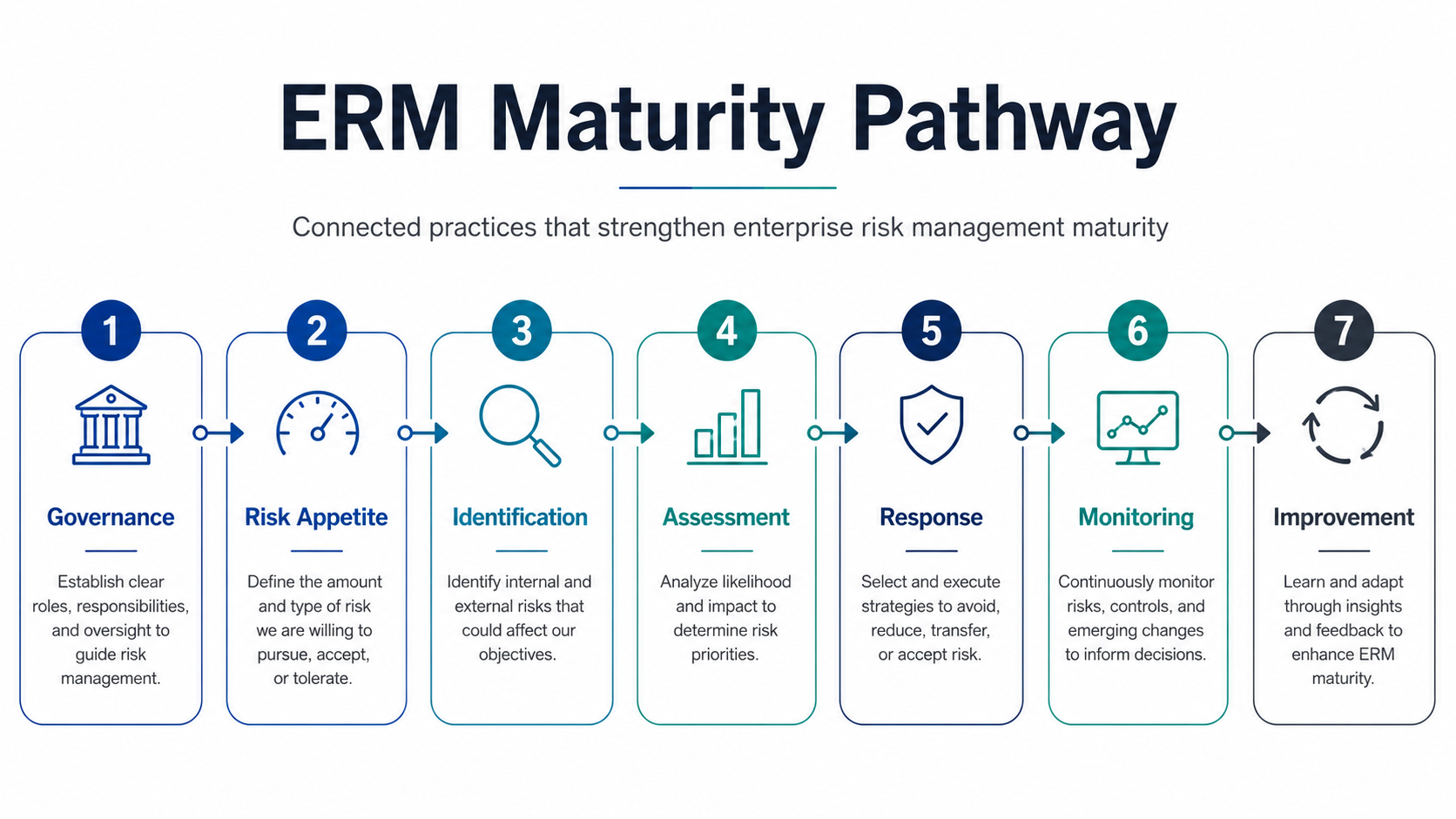
In a mature ERM environment, governance, risk appetite, risk assessment, response, monitoring, reporting, and continuous improvement reinforce one another. Risk information is not only collected. It is used.
Questions That Reveal the Practice Gap
A few practical questions often reveal whether ERM is operating as a decision-support system or only as a formal process:
- Is there clear executive or board-level risk oversight?
- Is risk appetite documented and used in decision-making?
- Are material risks consistently identified and prioritized?
- Are risk owners accountable for treatment plans?
- Are risks monitored through meaningful reporting and key risk indicators?
- Is the ERM program periodically reviewed and improved?
These questions matter because they focus on the connective tissue of ERM. They look beyond whether a document exists and ask whether the practice is embedded, repeatable, and useful.
ERM Maturity Is About Connection
ERM maturity is not measured only by the volume of documentation or the frequency of reporting. It is reflected in the extent to which risk practices are connected across the organization.
For example, risk appetite should inform strategic planning and decision-making. Risk identification should feed into assessment and prioritization. Risk owners should be accountable for response and treatment plans. Monitoring should provide timely insight into changing risk conditions. Periodic review should help the organization learn, adapt, and strengthen the ERM program over time.
When these elements are disconnected, ERM may look complete but remain limited in practical value. When they are connected, ERM becomes more useful to boards, executives, risk leaders, legal and compliance teams, internal audit, and governance professionals.
Why AGTC Created the ERM Maturity Navigator
AGTC Advisory Services created the AGTC ERM Maturity Navigator to help organizations move beyond a basic yes-or-no view of ERM.
The Navigator is a self-serve enterprise risk management maturity assessment designed to help users evaluate ERM practices, identify maturity gaps, and prioritize practical improvement actions. It is aligned with ISO 31000:2018 and COSO ERM and focuses on practical insight rather than generic scoring.
The assessment helps users examine areas such as governance and oversight, risk appetite, risk identification, risk assessment, risk response, monitoring and reporting, review and improvement, and related data, technology, and disclosure-readiness practices.
From “Do We Have ERM?” to “How Useful Is It?”
For many organizations, the starting question is whether an ERM program exists. That is an important first step, but it is not enough.
A more useful question is whether the ERM program is mature enough to support decisions, oversight, accountability, resilience, and improvement.
That shift is important for boards and executives because risk oversight depends on more than receiving risk reports. It requires confidence that the risk information is complete, current, prioritized, and connected enough to support meaningful discussion and action.
Two Practical Starting Points
Organizations and professionals can begin with the Free ERM Snapshot, a shorter assessment designed to provide a starting-point view of ERM maturity through web-based results.
Users who want a fuller assessment experience can proceed to the ERM Professional Self-Assessment, which includes the full Professional questionnaire, save/resume functionality, maturity scoring, maturity gates, recommendations, dashboard access, and a secure downloadable PDF report. The Professional Self-Assessment is currently available at an early access price of $395. The regular price is expected to be $895.
Explore the ERM Maturity Navigator
Use the AGTC ERM Maturity Navigator to evaluate where ERM practices are connected, where maturity gaps may exist, and which improvement actions should be prioritized.
Explore the ERM Maturity Navigator
Start with the Free ERM Snapshot
Important Disclaimer
The AGTC ERM Maturity Navigator is an informational self-assessment and reporting tool. It is not an audit, assurance opinion, certification, legal opinion, regulatory compliance determination, or standards-body endorsement.