
Effective enterprise risk management and ERM maturity are not about the number of policies, reports, or risk registers an organization has in place. It is about whether risk management is connected to strategy, informs decisions, and strengthens long-term performance and resilience.
Boards and executives play a critical role in setting the tone for ERM. They also have a responsibility to understand whether risk management is functioning as a practical decision-support system or operating mainly as a documentation and reporting exercise.
The following six questions provide a practical lens for assessing whether an ERM program has moved beyond formal structure and is becoming a source of insight, accountability, and continuous improvement.
 1. Is ERM clearly connected to strategy and objectives?
ERM should help the organization achieve its objectives, not exist in parallel to them. Top risks and risk responses should reflect strategic priorities, operating realities, market conditions, stakeholder expectations, and emerging threats.
For boards and executives, the key question is whether risk information is being used to support strategic discussion, resource allocation, performance management, investment decisions, and resilience planning.
 2. Is risk appetite used in real decisions?
Risk appetite should guide choices about where to invest, what to pursue, what to avoid, and what level of uncertainty the organization is willing to accept. A risk appetite statement is useful only if it is understood, communicated, and applied.
If risk appetite is documented but not used in decision-making, escalation, risk treatment, or management reporting, the organization may have a formal artifact rather than a mature management practice.
 3. Are top risks identified and prioritized consistently?
Top risks should be identified across the enterprise through a structured, inclusive process. They should be prioritized based on impact, likelihood, velocity, interdependencies, and relevance to strategic objectives.
A mature ERM program does not only maintain a risk inventory. It helps leadership distinguish between risks that are visible, risks that are material, and risks that require coordinated action.
 4. Are risk owners accountable for response and performance?
Risk ownership should be clear for each significant risk. That includes defined actions, resources, timelines, escalation expectations, and, where appropriate, performance indicators.
Accountability should be visible and reinforced through management oversight and reporting. Without clear ownership, risk treatment plans can remain aspirational rather than operational.
 5. Is risk information meaningful and fit for oversight?
Risk reporting should help leadership understand what matters most. Mature reporting is not simply more frequent or more detailed. It is focused, timely, decision-useful, and forward-looking.
Key risk indicators, trend information, treatment status, emerging risks, and changes in exposure should help boards and executives understand whether risks are moving within or outside acceptable levels.
 6. Is the ERM program reviewed and improved over time?
ERM maturity requires reflection, learning, and adaptation. The program should be periodically reviewed to determine whether the process is effective, whether reporting is useful, whether roles remain clear, and whether risk practices are keeping pace with the organization’s context.
Continuous improvement is especially important because the risk environment does not remain static. Governance, technology, regulation, markets, business models, and stakeholder expectations continue to evolve.
Why These Questions Matter
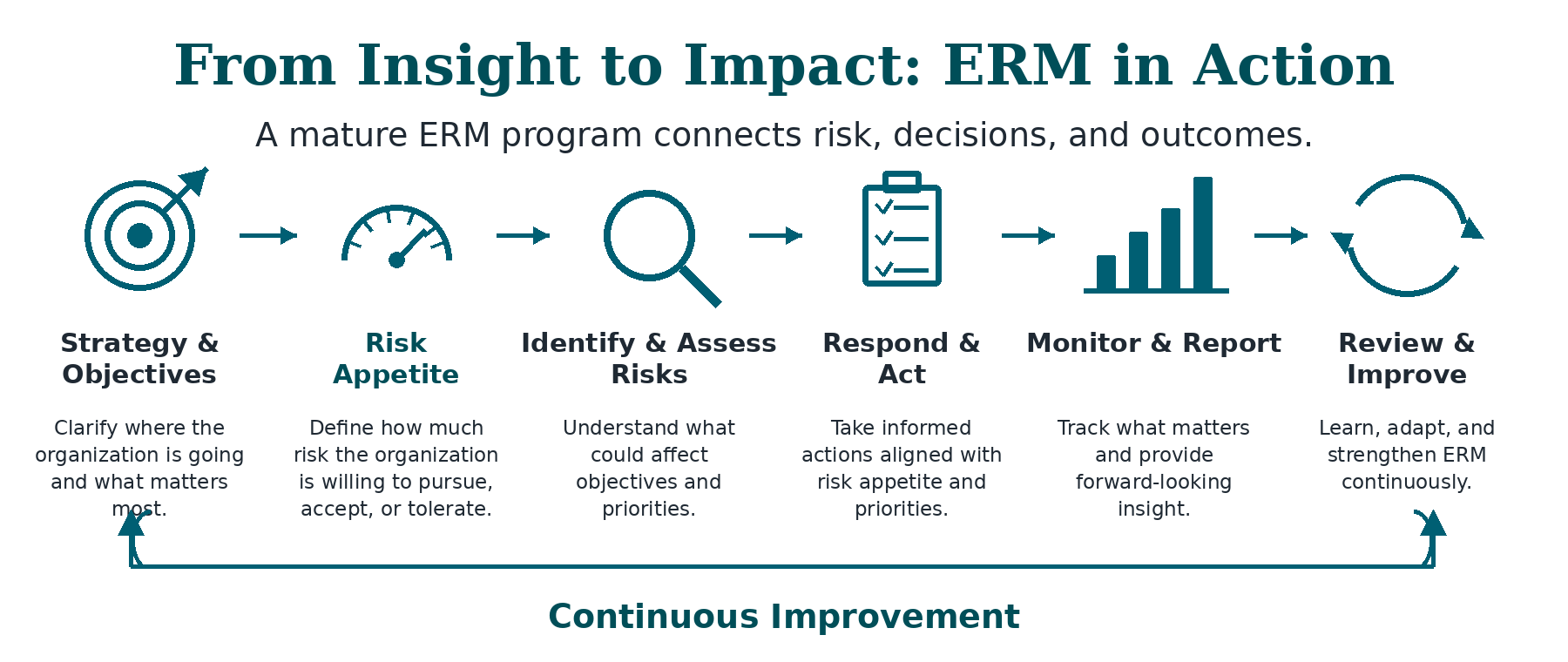
These six questions reflect the intent of ISO 31000:2018 and COSO ERM: risk management should be integrated, customized to context, connected to objectives, supported by leadership, applied through a structured process, and improved over time.
This distinction is important. ERM maturity should not be assessed solely by the existence of policies, risk registers, committees, or reports. Those elements are useful, but they do not necessarily indicate whether risk management is embedded in the organization’s decision-making and uncertainty management.
When ERM is mature, leaders have better information, clearer accountability, stronger oversight, and a more disciplined way to respond to uncertainty. That helps the organization become more resilient, agile, and prepared for future conditions.
Where to Start
If any of these questions raise uncertainty, the organization is not alone. Many boards, executives, risk leaders, legal and compliance teams, and internal audit professionals are looking for a clearer way to evaluate where ERM practices stand today and where improvement should begin.
The AGTC ERM Maturity Navigator was created to support that starting point. It is a self-serve enterprise risk management maturity assessment designed to help users evaluate ERM practices, identify maturity gaps, and prioritize practical improvement actions.
The Navigator is aligned with ISO 31000:2018 and COSO ERM. It is designed to provide practical insight rather than generic scoring, with a focus on whether ERM practices are connected, decision-useful, and improving over time.
Explore the AGTC ERM Maturity Navigator
Assess where your ERM practices stand today, identify opportunities for improvement, and build a stronger foundation for decision-making and resilience.
Important Disclaimer
The AGTC ERM Maturity Navigator is an informational self-assessment and reporting tool. It is not an audit, assurance opinion, certification, legal opinion, regulatory compliance determination, or standards-body endorsement.